 | TODAY IN SCIENCE HISTORY NEWSLETTER - 7 AUGUST | aa
| Feature for Today |
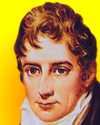 Today, a double feature. Choose your own adventure between two engineers. One built steam boats, the other a canal to be used by boats. The name of one you may recognize, but despite the achievement of the other, his name is likely unknown to you. Today, a double feature. Choose your own adventure between two engineers. One built steam boats, the other a canal to be used by boats. The name of one you may recognize, but despite the achievement of the other, his name is likely unknown to you.On 7 Aug 1807, Robert Fulton's North River Steam Boat (also known as the Clermont) began chugging its way up New York's Hudson River on its successful round-trip from New York City to Albany 150 miles apart in 32 hours. In this chapter from Cradle Days of New York on The First Steamboat, you find an account of how he brought steamboating from the experimental stage to commercial success. As you read, you realize that it took more than being an inventor. His success and fame also required being an astute businessman, and able to aggressively deal with legal challenges. 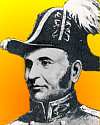 On 7 Aug 1779, John By was born, the English military engineer who constructed the 126-mile (202-km) Rideau Canal connecting the Ottawa River and Lake Ontario, Canada. Thus he provided a connection between the tidal waters of the St. Lawrence and the great lakes of Canada. He chose for his headquarters a position near the mouth of the proposed canal, a little below the beautiful Chaudière falls of the Ottawa River. A town soon sprang up there, and was named after him as Bytown. Sadly, his accomplishment, of immense value to the nation, was not given the recognition he deserved because of politics. After his death, the name of Bytown was replaced by the city name you do know: Ottawa. Curious about this engineer's efforts and ordeals? Here is a biography of John By. On 7 Aug 1779, John By was born, the English military engineer who constructed the 126-mile (202-km) Rideau Canal connecting the Ottawa River and Lake Ontario, Canada. Thus he provided a connection between the tidal waters of the St. Lawrence and the great lakes of Canada. He chose for his headquarters a position near the mouth of the proposed canal, a little below the beautiful Chaudière falls of the Ottawa River. A town soon sprang up there, and was named after him as Bytown. Sadly, his accomplishment, of immense value to the nation, was not given the recognition he deserved because of politics. After his death, the name of Bytown was replaced by the city name you do know: Ottawa. Curious about this engineer's efforts and ordeals? Here is a biography of John By. |
| Book of the Day | |
| |
| Quotations for Today | |
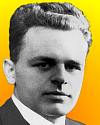 | "For many years I have been a night watchman of the Milky Way galaxy." - Bart J. Bok, Dutch-American astronomer (died 7 Aug 1983)  |
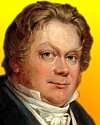 | "The habit of an opinion often leads to the complete conviction of its truth, it hides the weaker parts of it, and makes us incapable of accepting the proofs against it." - Swedish chemist, in the quiz below (died 7 Aug 1848) |
| QUIZ | |
| Before you look at today's web page, see if you can answer some of these questions about the events that happened on this day. Some of the names are very familiar. Others will likely stump you. Tickle your curiosity with these questions, then check your answers on today's web page. | |
| Births | |
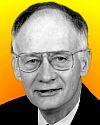 |  William Ross Maples, born 7 Aug 1937, American forensic anthropologist who examined and identified the skeletons of a number of historical figures, including a famous Russian family. William Ross Maples, born 7 Aug 1937, American forensic anthropologist who examined and identified the skeletons of a number of historical figures, including a famous Russian family. Who were the Russian family he identified? Who were the Russian family he identified? |
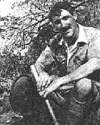 | Louis Leakey, born 7 Aug 1903, was an archaeologist and anthropologist, was born in Kabete, Kenya, of English missionaries parents. Leakey was largely responsible for convincing scientists that Africa, rather than Java or China, was the most significant area to search for evidence of human origins. Leakey led fossil-hunting expeditions to eastern Africa from the 1920's.What were the most significant fossils he found? |
| Deaths | |
| |  A Swedish chemist (1779-1848) was one of the founders of modern chemistry by his determination of atomic weights and the development of modern chemical symbols (such as Fe, F).Can you name this man? A Swedish chemist (1779-1848) was one of the founders of modern chemistry by his determination of atomic weights and the development of modern chemical symbols (such as Fe, F).Can you name this man? |
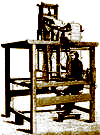 | Joseph Marie Jacquard (1752-1834)was a silk weaver whose invention for his industry included a concept that was later used for US census data.What was his innovation which was adapted later for processing cenus data? |
| Events | |
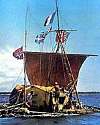 |  On 7 Aug 1947, Thor Heyerdahl and five companions, completed their crossing of the Pacific Ocean, a voyage of more than 4,000 miles, when their vessel crashed into a reef at Raroia in the Tuamotu Islands in the Pacific Ocean. Their raft was built using materials and methods of pre-Columbian times. Their mission was to demonstrate ancient Polynesians may have originated in South America by making a similar sea voyage.What was the name of their raft? On 7 Aug 1947, Thor Heyerdahl and five companions, completed their crossing of the Pacific Ocean, a voyage of more than 4,000 miles, when their vessel crashed into a reef at Raroia in the Tuamotu Islands in the Pacific Ocean. Their raft was built using materials and methods of pre-Columbian times. Their mission was to demonstrate ancient Polynesians may have originated in South America by making a similar sea voyage.What was the name of their raft? |
| Answers |
When you have your answers ready to all the questions above, you'll find all the information to check them, and more, on the August 7 web page of Today in Science History. Or, try this link first for just the brief answers. Fast answers for the previous newsletter for August 6: Internet's address system of names and numbers; penicillin; due to an asymmetric carbon atom bound to four different groups; 10.3 year cycle; a fossil found on a meteorite believed to have come from Mars; Hiroshima; the decade including the year 1890. |
| Feedback |
 If you enjoy this newsletter, the website, or wish to offer encouragement or ideas, please send feedback by using your mail reader Reply button. If you enjoy this newsletter, the website, or wish to offer encouragement or ideas, please send feedback by using your mail reader Reply button. |

--
If you do not want to receive any more newsletters, this link
To update your preferences and to unsubscribe visit this link
If you do not want to receive any more newsletters, this link
To update your preferences and to unsubscribe visit this link
! !

Δεν υπάρχουν σχόλια:
Δημοσίευση σχολίου