 | TODAY IN SCIENCE HISTORY NEWSLETTER - 8 OCTOBER |
| Feature for Today |
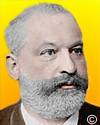 On 8 Oct 1904, Clemens Winkler, German chemist died. Although his name may be unfamiliar to you, he is notable for discovering a new element. (Its name is a quiz question below.) On 8 Oct 1904, Clemens Winkler, German chemist died. Although his name may be unfamiliar to you, he is notable for discovering a new element. (Its name is a quiz question below.)His eventual discovery of this new element was the result of months of work in the laboratory on the mineral argrodite. An account of Winkler and the Discovery of Germanium in The Discovery of the Elements (1934) makes interesting reading. You may be surprised by the crucial step that made all the difference in finding the new element when his months of previous efforts had been fruitless. |
| Book of the Day | |
| |

| Quotations for Today | |
 | "The psychopaths are always around. In calm times we study them, but in times of upheaval, they rule over us." (1963) - Ernst Kretschmer, German psychiatrist (born 8 Oct 1888)  |
 | "In my opinion the separation of the c- and ac-stars is the most important advancement in stellar classification since the trials by Vogel and Secchi ... To neglect the c-properties in classifying stellar spectra, I think, is nearly the same thing as if a zoologist, who has detected the deciding differences between a whale and a fish, would continue classifying them together. " - Ejnar Hertzsprung, Danish astronomer (born 8 Oct 1873) |
| | "It is well-known that both rude and civilized peoples are capable of showing unspeakable, anbd as it is erroneously termed, inhuman cruelty towards each other. These acts of cruelty, murder and rapine are often the result of the inexorable logic of national characteristics, and are unhappily truly human, since nothing like them can be traced in the animal world. It would, for instance, be a grave mistake to compare a tiger with the bloodthirsty exectioner of the Reign of Terror, since the former only satisfies his natural appetite in preying on other mammals. The atrocities of the trials for witchcraft, the indiscriminate slaughter committed by the negroes on the coast of Guinea, the sacrifice of human victims made by the Khonds, the dismemberment of living men by the Battas, find no parallel in the habits of animals in their savage state. And such a comparision is, above all, impossible in the case of anthropoids, which display no hostility towards men or other animals unless they are first attacked. In this respect the anthropid ape stands on a higher plane than many men. " - Robert Hartmann, German zoologist, anatomist and ethnographer (born 8 Oct 1832) |
| QUIZ | |
| Before you look at today's web page, see if you can answer some of these questions about the events that happened on this day. Some of the names are very familiar. Others will likely stump you. Tickle your curiosity with these questions, then check your answers on today's web page. | |
| Births | |
| |  Ejnar Hertzsprung, born 8 Oct 1873, was a Danish astronomer who classified types of stars by relating their surface temperature (or colour) to their absolute brightness. A few years later, working with another scientist, Hertzsprung illustrated this relationship graphically in a diagram now known by both their names. It has become fundamental to the study of stellar evolution. Ejnar Hertzsprung, born 8 Oct 1873, was a Danish astronomer who classified types of stars by relating their surface temperature (or colour) to their absolute brightness. A few years later, working with another scientist, Hertzsprung illustrated this relationship graphically in a diagram now known by both their names. It has become fundamental to the study of stellar evolution. What is the name of the second scientist with whom he prepared the graphical diagram? What is the name of the second scientist with whom he prepared the graphical diagram? |
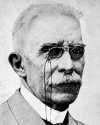 | A French chemist, born 8 Oct 1850, is best known for the principle makes it possible to predict the effect a change of conditions (temperature, pressure, and concentration of reaction components) will have on a chemical reaction. This principle proved invaluable in the chemical industry for developing the most efficient chemical processes. Can you name this scientist? |
| Deaths | |
| |  Clemens Alexander Winkler (1838-1904) discovered a new element (6 Feb 1886). He had a background in managing a cobalt glassworks and then on the faculty of the Freiberg School of Mining, when he discovered the new element in the mineral argyrodite. He named it for his country.What was the element he discovered and named? Clemens Alexander Winkler (1838-1904) discovered a new element (6 Feb 1886). He had a background in managing a cobalt glassworks and then on the faculty of the Freiberg School of Mining, when he discovered the new element in the mineral argyrodite. He named it for his country.What was the element he discovered and named? |
| Events | |
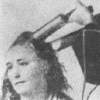 |  On 8 Oct of a certain year, a German, Karl Ludwig Nessler, demonstrated the first "permanent wave" for hair, in his beauty salon in Oxford Street, London, to an invited audience of hair stylists. The hair was soaked with an alkaline solution and rolled on metal rods which were then heated strongly.In what decade did this event occur? On 8 Oct of a certain year, a German, Karl Ludwig Nessler, demonstrated the first "permanent wave" for hair, in his beauty salon in Oxford Street, London, to an invited audience of hair stylists. The hair was soaked with an alkaline solution and rolled on metal rods which were then heated strongly.In what decade did this event occur? |
| Answers |
When you have your answers ready to all the questions above, you'll find all the information to check them, and more, on the October 8 web page of Today in Science History. Or, try this link first for just the brief answers. Fast answers for the previous newsletter for October 7: Buckminster Fuller, whose geodesic dome structure they resembled; Niels Bohr; fish; the decade containing the years 1954, 1957; to help the blind write; the "black paper" was really just a substitute for ink. |
| Feedback |
 If you enjoy this newsletter, the website, or wish to offer encouragement or ideas, please send feedback by using your mail reader Reply button. If you enjoy this newsletter, the website, or wish to offer encouragement or ideas, please send feedback by using your mail reader Reply button. |

--
If you do not want to receive any more newsletters, this link
To update your preferences and to unsubscribe visit this link
If you do not want to receive any more newsletters, this link
To update your preferences and to unsubscribe visit this link
! !


Δεν υπάρχουν σχόλια:
Δημοσίευση σχολίου