 | TODAY IN SCIENCE HISTORY NEWSLETTER - 5 AUGUST |
| Feature for Today |
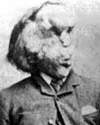 On 5 Aug 1862 Joseph Carey Merrick was born, who even while still an infant started to show the disfigurement for which he was to become known as “the Elephant Man.” He lived to only age 26. His final years were spent as a resident patient of London Hospital. On 5 Aug 1862 Joseph Carey Merrick was born, who even while still an infant started to show the disfigurement for which he was to become known as “the Elephant Man.” He lived to only age 26. His final years were spent as a resident patient of London Hospital.He was the subject of newspaper reports, and journal articles by Dr Frederick Treves, who compassionately studied Merrick's condition. When Merrick died in 1890, The Speaker published a sympathetic story on his life, though under the heading The Story of an Outcast. In the Medical Mirror, the Obituary for Joseph Merrick, was also respectful. An article published earlier (New York Medical Abstract, 1886) on The “Elephant Man” summarized Dr. Treve's medical description from the British Medical Journal. (The copy on this site has images added from a 1901 medical book of the doctor's illustrations of the deformities which affected Merrick's whole body.) You surely already have heard of the “Elephant Man,” but these three articles will give you a direct impression of how Merrick was viewed at the time he was alive, and before a modern diagnosis was possible. |
| Book of the Day | |
| |

| Quotations for Today | |
 | "In flying, the probability of survival is inversely proportional to the angle of arrival." - American astronaut, in the quiz below (born 5 Aug 1930)  |
 | About Gauss' mathematical writing style: "He is like the fox, who effaces his tracks in the sand with his tail." - Niels Henrik Abel, Norwegian mathematician (born 5 Aug 1802) |
| QUIZ | |
| Before you look at today's web page, see if you can answer some of these questions about the events that happened on this day. Some of the names are very familiar. Others will likely stump you. Tickle your curiosity with these questions, then check your answers on today's web page. | |
| Births | |
| |  Born on 5 Aug 1930, this astronaut was the first man to walk on the moon. (20 Jul 1969, Apollo 11). Born on 5 Aug 1930, this astronaut was the first man to walk on the moon. (20 Jul 1969, Apollo 11).  Can you name him? Can you name him? |
 | Joseph Carey Merrick (erroneously referred to as John Merrick) was a disfigured person, born in Leicester, England, on 5 Aug 1862. Merrick began to develop tumors on his face before his second birthday. His condition quickly worsened as bulbous, cauliflower-like growths grew from his head and body, and his right hand and forearm became a useless club. After a brief career as a professional “freak,” dubbed the “Elephant Man,” he became the best-known resident patient of London Hospital from 1886 until his death.What feature evoked the name “Elephant Man”? |
| Deaths | |
| |  Thomas Newcomen (1663-1729), inventor of the atmospheric steam engine, died in London. His invention of c.1711 came into use to pump water. It had a piston connected to one end of a large crossbeam; the other end was connected to a very heavy pump piston. On each stroke, water chilled and condensed the steam in the cylinder, dropping the piston thus moving the crossbeam and operating the pump. This was wasteful of fuel needed to reheat the cylinder for the next stroke. Although it was slow and inefficient, Newcomen's engine was relied on for the first 60 years of the new steam age it began.Where in industry was this invention used? Thomas Newcomen (1663-1729), inventor of the atmospheric steam engine, died in London. His invention of c.1711 came into use to pump water. It had a piston connected to one end of a large crossbeam; the other end was connected to a very heavy pump piston. On each stroke, water chilled and condensed the steam in the cylinder, dropping the piston thus moving the crossbeam and operating the pump. This was wasteful of fuel needed to reheat the cylinder for the next stroke. Although it was slow and inefficient, Newcomen's engine was relied on for the first 60 years of the new steam age it began.Where in industry was this invention used? |
| Events | |
 |  On 5 Aug 1962, a lunar occultation enabled Australian radio astronomers to more precisely fix the location of the previously known radio source 3C 273, in Virgo. In 1963 this became the first member of a new class of object eventually to be called quasars. What does the name quasar mean? On 5 Aug 1962, a lunar occultation enabled Australian radio astronomers to more precisely fix the location of the previously known radio source 3C 273, in Virgo. In 1963 this became the first member of a new class of object eventually to be called quasars. What does the name quasar mean? |
| Answers |
When you have your answers ready to all the questions above, you'll find all the information to check them, and more, on the August 5 web page of Today in Science History. Or, try this link first for just the brief answers. Fast answers for the previous newsletter for August 4: pencil; behaviour of chromosomes; illuminating gas; the decade including the year 1958; in memory of Alexander Graham Bell, who had died two days earlier; champagne. |
| Feedback |
 If you enjoy this newsletter, the website, or wish to offer encouragement or ideas, please send feedback by using your mail reader Reply button. If you enjoy this newsletter, the website, or wish to offer encouragement or ideas, please send feedback by using your mail reader Reply button. |

--
If you do not want to receive any more newsletters, this link
To update your preferences and to unsubscribe visit this link
If you do not want to receive any more newsletters, this link
To update your preferences and to unsubscribe visit this link
! !


Δεν υπάρχουν σχόλια:
Δημοσίευση σχολίου