 | TODAY IN SCIENCE HISTORY NEWSLETTER - 10 OCTOBER |
| Feature for Today |
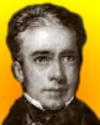 On 10 Oct 1797, Thomas Drummond was born, the Scottish civil engineer who invented the Drummond light (similar to limelight illumination in theatres). Curiously, he developed it to meet his need for a light marking a station when surveying at night. On 10 Oct 1797, Thomas Drummond was born, the Scottish civil engineer who invented the Drummond light (similar to limelight illumination in theatres). Curiously, he developed it to meet his need for a light marking a station when surveying at night. The Drummond light produced a bright light, using an oxygenated alcohol flame, he heated a small ball of lime to incandescent in front of a reflector. He attempted to adapt it for use in lighthouses. Another of innovations for surveying was his improved design of the Heliostat. An account of his Heliostat and Drummond Light can be read in Drummond's Inventions from Memoir of Thomas Drummond (1867). |
| Book of the Day | ||
|

| Quotations for Today | |
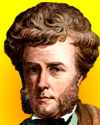 | Nature is a vast tablet, inscribed with signs, each of which has its own significancy, and becomes poetry in the mind when read; and geology is simply the key by which myriads of these signs, hitherto indecipherable, can be unlocked and perused, and thus a new province added to the poetical domain. - Hugh Miller, Scottish geologist and theologian (born 10 Oct 1802).  |
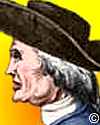 | A small bubble of air remained unabsorbed... if there is any part of the phlogisticated air [nitrogen] of our atmosphere which differs from the rest, and cannot be reduced to nitrous acid, we may safely conclude that it is not more than 1/120 part of the whole. Cavendish did not realize the significance of the remaining small bubble. Not until a century later were the air�s Noble Gases appreciated. - Henry Cavendish, English chemist and physicist (born 10 Oct 1731). |
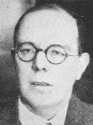 | Attainment is a poor measure of capacity, and ignorance no proof of defect. - Sir Cyril Burt, English psychologist (died 10 Oct 1971). |
| Quiz | |
| Before you look at today's web page, see if you can answer some of these questions about the events that happened on this day. Some of the names are very familiar. Others will likely stump you. Tickle your curiosity with these questions, then check your answers on today's web page. | |
| Births | |
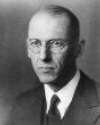 | Lester Germer, born 10 Oct 1896, was an American physicist who, with his colleague Clinton Joseph Davisson, conducted an experiment (1927) that first demonstrated the wave properties of the electron. This experiment confirmed the hypothesis of Louis-Victor de Broglie, a founder of wave mechanics, that the electron should show the properties of an electromagnetic wave as well as a particle. What wave property of electrons did they demonstrate in their experiment? What wave property of electrons did they demonstrate in their experiment? |
| | Henry Cavendish, born 10 Oct 1731, was an English physicist and chemist, born in Nice, who conducted experiments in diverse fields, discovering such phenomena as the composition of air, the specific heat of certain substances, the composition of water, and various properties of electricity. He is known for investigating the properties of which particular gas? |
| Deaths | |
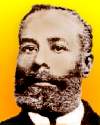 | Elijiah McCoy (1843-1929) was a Black-American inventor holding many patents, including an ironing table, scaffold support and rubber heel. But he was best known for variety of inventions important in the operation of steam engines, whether stationary, locomotives or boats. For what type of devices designed for steam engines was McCoy famous? |
| Events | |
 | On 10 Oct of a certain year, a U.S. patent was issued to Waldo L. Semon for a method of making plasticized PVC, now known simply as vinyl. As originally known, PVC - polyvinyl chloride - was a polymer that was hard and difficult to form into useful articles. Semon had invented a way to make it in a rubber-like form. In what decade was this patent issued? |
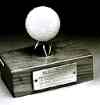 | On 10 Oct 1865, the first U.S. patent for a billiard ball of a composition material resembling ivory was patented by John Wesley Hyatt. He was the winner of a $10,000 prize offered by Phelan and Collender of New York City for the best substitute for an ivory ball. While still searching for substitute materials for making billiard balls, what plastic did he invent? |
| Answers |
| When you have your answers ready to all the questions above, you'll find all the information to check them, and more, on the October 10 web page of Today in Science History. Or, try this link first for just the brief answers. Fast answers for the previous newsletter for October 9: Max Von Laue • the decade containing the year 1957 • Hoover Dam • the expedition was permitted by the British officer to land and observe the eclipse of 27 Oct 1780. |
| Feedback |
 If you enjoy this newsletter, the website, or wish to offer encouragement or ideas, please send feedback by using your mail reader Reply button. If you enjoy this newsletter, the website, or wish to offer encouragement or ideas, please send feedback by using your mail reader Reply button. Your click on a StumbleUpon, Google+ or Facebook social button on the site webpages is also a welcome sign of appreciation. Thank you for using them. |
| Copyright |
| To find citations for quotations go to the corresponding webpage by clicking on the “quotes” balloon icon. Sources for the thumbnails appear on today's webpage with the corresponding item. � This newsletter is copyright 2013 by todayinsci.com. Please respect the Webmaster's wishes and do not put copies online of the Newsletter � or any Today in Science History webpage. (If you already have done so, please remove them. Thank you.) Offline use in education is encouraged such as a printout on a bulletin board, or projected for classroom viewing. Online, descriptive links to our pages are welcomed, as these will provide a reader with the most recent revisions, additions and/or corrections of a webpage. For any other copyright questions, please contact the Webmaster by using your mail reader Reply button. |
--
If you do not want to receive any more newsletters, Unsubscribe
To update your preferences and to unsubscribe visit this link


Δεν υπάρχουν σχόλια:
Δημοσίευση σχολίου